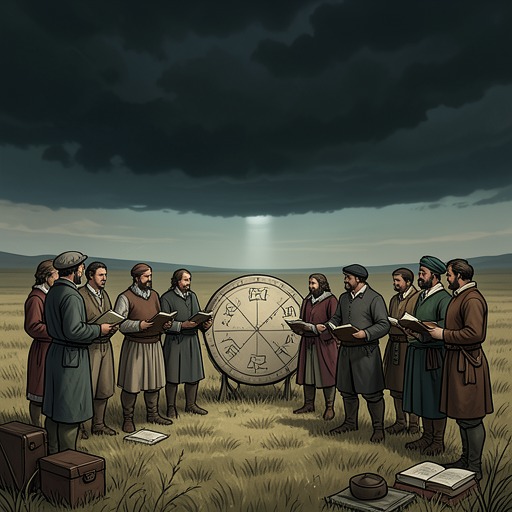
Hartland Point Weapon Demonstration
Last and First MenThe Hartland Point Weapon Demonstration is the pivotal test of a device that can annihilate matter remotely, and a turning point in the war between Europe and the United States. Its inventor destroys an island to prove the instrument works, then uses it against an American air fleet after the gathered scientists reverse their unanimous decision to destroy it. The act checks the fleet but transforms a military setback into a political disaster: the Americans’ response helps doom Europe, while the secret itself becomes both a forbidden scientific inheritance and a later religious legend.
War and the meeting
The demonstration takes place during a war that neither Europe nor the United States had wanted. Financial competition and resentment had already strained their relations. Europe had chafed under American financial influence, while American business interests feared the damage that destroying Europe would do to international finance. War followed a chain of escalating events: a murder in southern Italy, ill-judged remarks in the European press, an offensive response in the American press, the lynching of an Italian in the American Midwest, a massacre of American citizens in Rome, and the dispatch of an American air fleet to occupy Italy. European aircraft intercepted the fleet, briefly checking its advance, but the conflict was underway before it had formally been declared.
While the United States mobilizes, an international society of scientific workers meets in England. A young Chinese physicist requests an opportunity to report to a select committee on his experiments in using energy released by the annihilation of matter. The forty representatives travel from a meeting in Plymouth to Hartland Point, on the north coast of Devon. There, the President announces that the process has been achieved and that the assembled scientists will witness a demonstration. The meeting’s international character matters: the decision will not be made by one nation alone, even though its consequences will fall most heavily on the warring powers.
The instrument’s demonstration
The physicist produces an instrument resembling an old-fashioned rifle. He explains that it can initiate the annihilation of matter at a distance and in a precise direction, and that a second control can halt the process. Without that restraint, he says, annihilation could spread indefinitely. He presents the device as both a means of destruction and a potential source of effectively unlimited industrial power, claiming that scientists could use it to stop human conflict and direct the planet’s development.
To demonstrate its operation, he aims at Lundy Island, which is uninhabited and considered a danger to shipping. The device makes no immediate visible impression, but a growing point of light appears on the distant cliff. The island’s granite end breaks apart, and the resulting disturbance sends a great sea wave toward the coast, engulfing a coasting vessel and continuing toward Bideford and Barnstaple. The physicist watches with exultation, surprised by the scale of the effects. The demonstration establishes that the instrument is not merely a theoretical source of power: it can destroy a substantial target remotely, with consequences extending beyond the point aimed at.
The vote and the fleet
The scientists dispute what should be done with the weapon. Some see the possibility of stopping the war and placing immense power under organized scientific control. Others regard that promise as precisely the danger: the instrument could corrupt its possessors, turn them into tyrants, and ruin science itself. The meeting ultimately votes unanimously to order the destruction of both the device and every account of its construction. The physicist accepts the decision, though he resents the loss of ten years’ work and the prospect of being treated as an outcast rather than humanity’s benefactor.
The decision is overtaken by news that an American air fleet is approaching. The representatives see a line of aircraft in the western sky, and the assembled group calls for the fleet to be stopped. The United States representative supports the request despite having friends, and possibly his own son, among the airmen; he believes the fleet is about to commit a terrible act. The physicist looks to the President, who nods. He then aims at the aircraft one by one, and each disappears after becoming a point of intense light. The French representative breaks down in tears. In the immediate crisis, the instrument has changed from a rejected danger into the means by which the conference destroys the approaching force.
Consequences and historical memory
The conference promptly burns the instrument and the manuscript describing it. The physicist insists that he cannot remain alive while carrying the secret, because he believes he would remain a danger to the planet; after shaking hands with those present, he takes his own life. The secret is thus removed from the meeting in its usable written form, but its destruction does not end the consequences of the demonstration.
News spreads that an island has been exploded and an American fleet annihilated, and that scientists had gathered in the area. The European Government seeks the unknown figure who saved Europe and the process that made the feat possible. When the scientific society’s President recounts the vote to destroy the weapon, he and his colleagues are arrested and subjected to pressure to disclose it. The Americans, meanwhile, had not initially intended to destroy England: their air commander had orders only to demonstrate above it while peace was negotiated. The destruction of the fleet instead provokes blind hatred and submerges the American peace party. The narrator therefore presents the physicist’s one hostile act as having doomed England rather than saved it.
The secret’s later reputation reverses the meeting’s decision to erase it. In a subsequent age, rival religious traditions claim the young Discoverer as a sacred figure who entrusted the secret to scientists because humanity was not ready to use it. The scientific profession becomes a closed corporation, and rumors persist that its members guard undisclosed technical knowledge. Meanwhile, the English scientist who survived the meeting by feigning research leads later investigators down a false path; their dangerous experiments cause deaths and destroy a college, while the true process remains undiscovered. The demonstration’s legacy is therefore not a reliable scientific inheritance but a mixture of institutional secrecy, religious reinterpretation, and misdirected research. Its central irony persists: the device is destroyed to prevent its misuse, yet its use in the crisis intensifies the war and helps set in motion wider ruin.